 Hopr
Hopr Metadata Privacy for Delay-Tolerant Applications
Hopr routes application traffic through an incentivized mixnet to obscure sender-recipient links and weaken timing and traffic-pattern correlation. Relays process one encrypted layer, while mixing and uniform packet sizes make correlation harder. Those protections require extra routing, computation, and sometimes deliberate waiting. The protocol therefore fits applications able to trade some immediacy for network-level privacy. Payload authenticity, endpoint security, and application reliability still need their own controls.
In short: Mixing obscures connection patterns by adding routing and delay, so applications must account for variable latency.
A Private Request From Entry to Exit
A private request begins when an entry node receives application data, selects an eligible route, and constructs an encrypted packet. The normal path depends on reachable relays and usable payment channels. If either prerequisite is missing, packet construction or forwarding must stop, or the integration must choose another valid route.
Packet Preparation
A session or application layer first divides data exceeding the packet payload limit. The entry node then pads each packet to the fixed wire size and applies layered encryption for the selected path. Route instructions remain inside those layers. A relay receives only the information needed to process its hop and identify the next destination.
Relay State Changes
Each relay removes one encryption layer, validates the packet, transforms its routing state, and forwards it. Mixing can hold a packet briefly and place it among unrelated traffic before transmission. These changes frustrate attempts to match a packet entering one connection with a packet leaving another.
Delivery and Recovery Evidence
Application-level delivery remains separate from relay compensation. A request-response application can treat the expected response as completion evidence, while a one-way system needs its own acknowledgement policy. If no usable route exists before transmission, the result is a transport failure, not an assumed delivery.
Applications Suited to Deliberate Latency
Application fit depends on whether metadata exposure matters more than immediate delivery. Asynchronous messages, background coordination, private service requests, and other delay-tolerant exchanges can absorb extra hops and mixing. The packet layer also gives developers a transport component they can place beneath a purpose-built session or request protocol.
Hard real-time interaction presents a different constraint. Voice, fast multiplayer control, and strict deadline systems may react poorly to variable delay unless the application has tested tolerances and a suitable fallback. Large continuous transfers also need fragmentation, flow control, ordering, and recovery above the packet layer.
What Does Hopr Hide?
Hopr targets connection metadata, including relationships among network addresses, transmission times, and observable packet sizes. Onion-style routing limits what each relay learns, fixed-size packets reduce size correlation, and mixing weakens timing links. The sender still knows its chosen route, and the destination necessarily receives the application data addressed to it.
The protection does not erase public blockchain activity or secure requests an application sends outside the mixnet. It also does not repair a compromised endpoint. Payload authenticity and integrity require the appropriate application or session layer, because packet encryption alone does not establish every property an application may need.
Packet Construction and Mixing
Packet construction combines route privacy, consistent framing, and per-hop processing. Each mechanism addresses a different signal an observer could otherwise use for correlation.
Layered Route Knowledge
The source constructs the encrypted path, but an intermediate relay processes only its own layer. The current packet specification permits zero to three relay hops on a forward or return path. A zero-relay path does not provide the unlinkability gained from multiple independent hops.
Uniform Sphinx Packets
The Sphinx-based format pads encrypted payloads to a fixed packet size. An observer cannot distinguish messages merely by comparing their wire lengths inside the mixnet. Data exceeding the packet payload limit needs fragmentation and reassembly in a higher layer, with ordering handled there as well.
Timing Disruption
Mixing groups traffic from unrelated transmissions and may delay selected packets across mixing cycles. This breaks the simple assumption that an outgoing packet immediately corresponds to the most recent incoming packet. Its effectiveness still depends on traffic volume, relay behavior, path diversity, and the observer's reach.
Relay Incentives and Settlement
Relay incentives compensate operators for the bandwidth, computation, and online availability needed to forward private traffic. Hopr connects compensation to protocol work without placing every packet event directly on a public blockchain.
Proof of Relay
Proof of relay ties a relay's ability to claim payment to successful forwarding across adjacent hops. Consecutive nodes exchange cryptographic material needed to complete the payment proof. A node therefore cannot obtain the same claim merely by accepting a packet and refusing to forward it.
Tickets and Payment Channels
Forwarding produces cryptographic tickets within funded payment channels. Channel balances can change off-chain as packets move, while later settlement records a reduced view on-chain. The blockchain coordinates value and claims; it does not carry the application payload through the relay route.
Probabilistic Redemption
Tickets use probabilistic rewards, so most do not produce an on-chain redemption while winning tickets represent larger claims. Expected compensation emerges across many tickets, although short runs can vary. Winning probability and ticket value are configurable protocol parameters. Channel funding and settlement timing depend on node operation, so this mechanism does not set a permanent price for application users.
A Worked Route With a Missing Prerequisite
The application request, relay identities, candidate route, channel state, and response in this example are hypothetical. A request-response application gives an encrypted request to its entry node. The node finds an eligible path with usable channels, builds the layered packet, and sends it through the relays. The destination application processes the request and returns the expected response.
Now assume one hypothetical outgoing channel on the candidate path is unavailable before packet construction finishes. That missing prerequisite prevents the node from creating a valid compensated route. If the integration supports route reselection, the node can try another eligible path. If no such path exists, it stops and reports a transport failure without claiming the request reached its destination.
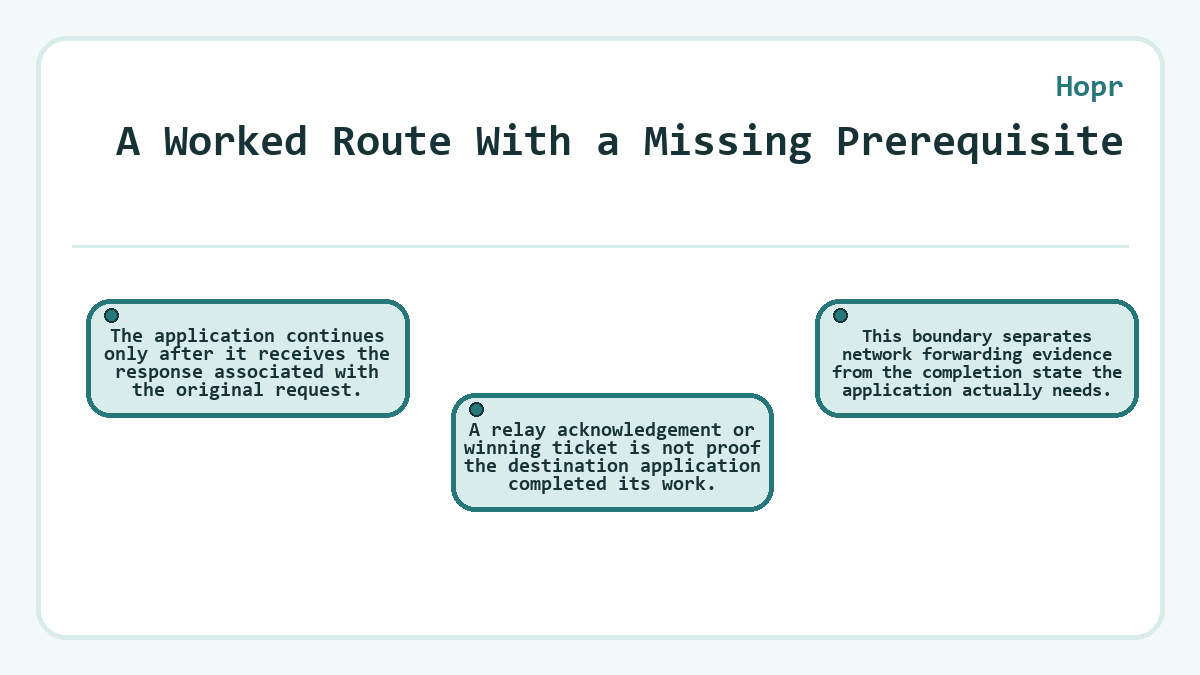
The application continues only after it receives the response associated with the original request. A relay acknowledgement or winning ticket is not proof the destination application completed its work. This boundary separates network forwarding evidence from the completion state the application actually needs.
How Much Delay Does Privacy Add?
Added delay has no universal value because route length, mixing behavior, network load, channel availability, packetization, and retry policy all affect it. A direct path avoids most of this work. A private path deliberately performs more processing and may wait to weaken timing correlation.
An integration should measure its own request sizes, deadlines, and failure behavior under realistic load. Timeouts must leave room for ordinary variance without treating every pause as permanent loss. Another transport becomes preferable when a hard deadline is shorter than the application's acceptable private-route delay.
Cover Traffic During Quiet Periods
Cover traffic adds packets without meaningful application content so real transmissions have more traffic to blend with. Relays process these packets like ordinary traffic and can receive protocol compensation for doing so. The mechanism matters when organic demand is too sparse to form a useful mixing set.
Cover traffic does not create absolute anonymity by itself. Protection still depends on how much traffic exists, where it travels, which relays an adversary controls, and whether endpoints leak related activity. A deployment should treat cover traffic as one layer of resistance, not as proof no correlation is possible.
Relay Operation and Fund Separation
Relay operation is a separate entry path from using an application built on the protocol. An operator needs a supported machine, reliable connectivity, node keys, stake, operating funds, and funded channels. Published participation requirements currently include onboarding and staking, so installing software alone does not establish an active relay.
SafeStaking separates administrative control from the chain key the running node uses for limited on-chain work. Spending permissions can restrict how much value the node accesses without fresh approval. This compartmentalization reduces exposure from a compromised relay process, although operators still need backups, updates, key protection, and monitoring.
Deployment Boundaries and Better Fits
A sound deployment starts with the threat being addressed. Hopr is relevant when observers might correlate communicating endpoints through address, timing, or size metadata. It cannot hide information an application publishes on-chain, prevent a destination from seeing received content, or protect traffic the application sends through another network path.
Endpoint compromise, colluding relays, sparse traffic, route failure, and application-layer leaks remain material limits. Standard encrypted transport may be enough when content confidentiality is the only requirement. Hopr offers its clearest benefit when sender-recipient unlinkability matters, the integration controls its surrounding data flows, and the workload can tolerate variable delivery time.
Hopr: common questions
-
Do Applications Need Their Own Delivery and Ordering Logic?
- Applications need an overlay or session layer when they require reliable, ordered delivery. The Hopr packet format does not depend on an ordered or reliable underlying transport, so packets may need fragmentation, reassembly, sequencing, acknowledgement, and retry above that layer. An integration can use a session protocol to provide those properties instead of implementing each one directly.
-
Can a Relay See the Sender and Final Recipient Together?
- A normal intermediate relay does not receive the complete route in readable form. It processes one encrypted layer and learns the adjacent forwarding information needed for its hop. That local view reduces sender-recipient linkage, but it is not immunity from endpoint compromise, relay collusion, traffic analysis, or an observer with information from several parts of the network.
-
Does Every Packet Produce a Blockchain Transaction?
- No, forwarding a packet produces a cryptographic ticket rather than an immediate blockchain transaction. Payment channels keep balance changes off-chain, and probabilistic tickets reduce how many claims need redemption. Winning tickets can later create settlement activity, while non-winning tickets do not. This separation lowers settlement overhead and weakens direct timing links between packet forwarding and public transactions.
-
Which Layer Handles Messages Larger Than One Hopr Packet?
- A higher application or session layer handles data exceeding the packet payload limit. That layer splits the message into suitable pieces, tracks their order, detects missing pieces, and reassembles the original data. The exact payload capacity belongs to the packet specification and implementation version, so an integration should read it from the interface it actually uses rather than assume a permanent number.
-
Must Users Hold Tokens to Use an Application Built on Hopr?
- A user does not necessarily need direct token custody if the application abstracts or funds the protocol interaction. The sending side still needs the economic resources required to compensate relays and maintain usable channels. Whether the end user supplies those resources, pays through another model, or never sees the payment layer depends on the application's design rather than the mixnet packet format.